Walking through a latent room impulse response
A room impulse response autoencoder, frozen and never fine-tuned, turns out to organise its latent space by microphone coordinate. Move the listener and the response moves with it — continuously, including through positions that were never measured.
Move the microphone
Drag anywhere on the map. Small dots are the 441 real measurement positions; every other pixel is a decoded impulse response at a coordinate nobody measured.
Continuous: defined at every coordinate, including the three quarters of the map that were never measured.
loading field…
What “moving in the latent space” actually means
Each measured impulse response h(x) is pushed through the encoder to a point
z(x) — 320 numbers. Do that for all 441 microphones and you get 441 points. They are not
scattered: they form a smooth two-dimensional sheet inside that 320-dimensional space, indexed by
where the microphone was standing.
So “moving” means: pick any coordinate, including one between microphones, read the corresponding point off that sheet by interpolating its neighbours, and run it through the decoder. What comes back is a 10 240-sample impulse response at 22.05 kHz — a real waveform you can listen to, for a position nobody ever measured.
Every position on the map above is one such decode. At the 441 measured spots it approximates the real recording; everywhere in between it is invented, and the point of the demo is that it is invented smoothly.
Where the position information lives
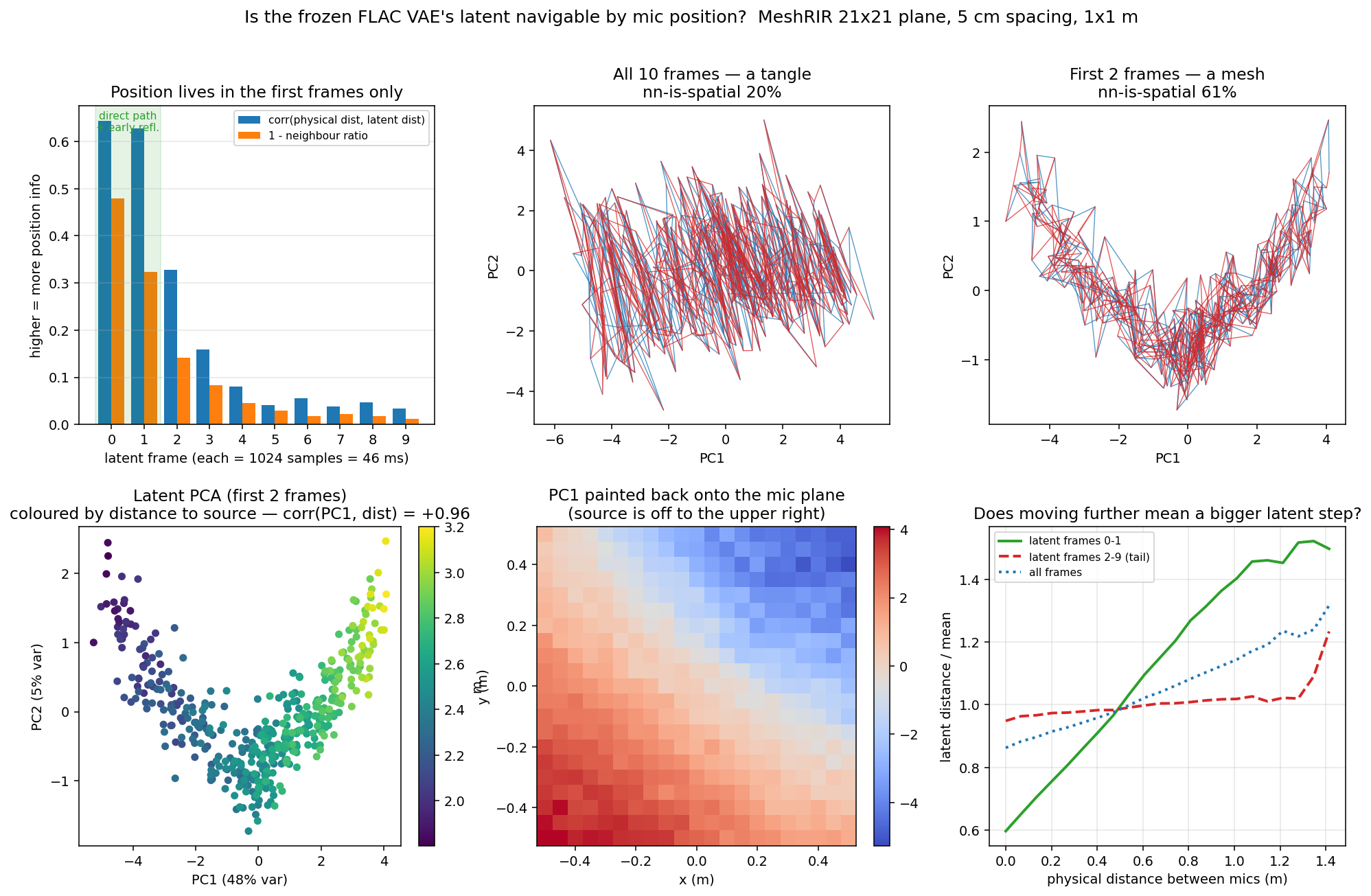
The latent is 32 channels × 10 time frames, each frame covering 46 ms of the response. Position is not spread evenly across it: it sits almost entirely in the first two frames, the direct sound and the early reflections. The remaining eight, the reverberant tail, carry very little.
That makes sense. This is one room, so the late field is diffuse and decays more or less the same way wherever you stand; there is no position information in it to find.
Use only those first two frames and the leading direction of the latent correlates 0.988 with the direct sound's time of arrival. Can we say: a frozen autoencoder, trained on a different dataset entirely, spends its main axis on time of flight?
Not good for:
Accuracy. Predicting a held-out microphone from its neighbours, simply copying the nearest measured response wins. Microphones 5 cm apart produce responses that differ by less than the autoencoder's own reconstruction error, so the model has nothing to add. Only when the measurements thin out to roughly half a metre does latent interpolation start to win.